



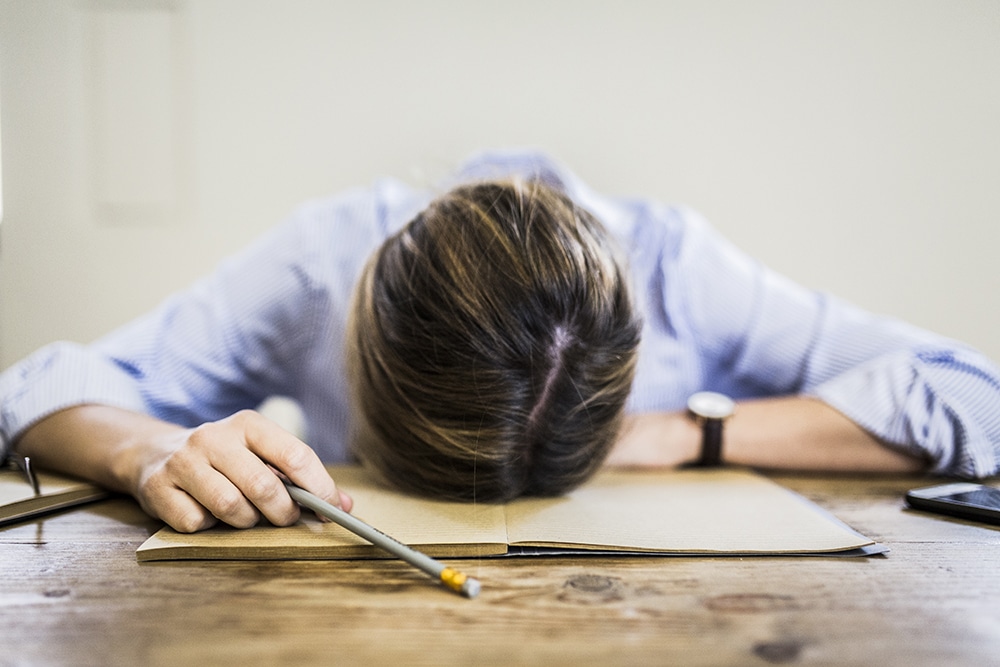
Excessive Daytime Sleepiness
Excessive daytime sleepiness is not usually a medical issue. It's often a symptom of not getting enough sleep the night before, and it can also be a side effect of a highly stressful 24 hours, which can quickly sap your energy reserves.
Feeling tired during the day is nothing to worry about, but it can impact your professional and social life, so finding a solution is essential.
This article explains why we sometimes have excessive daytime sleepiness to help us make positive changes in our life.
Let's jump in!
A word on hypersomnia
Firstly, there is a condition called hypersomnia which gives you an irresistible urge to sleep during the day. It is an inability to stay awake and alert during the day, despite having an adequate amount of night-time sleep.
If this matches the description of your problems, you should speak to your GP, who will refer you to a sleep specialist. A typical treatment is a medicine that keeps you awake, but sleep training can also work wonders for hypersomnia.
Excessive daytime sleepiness causes
If we can rule out hypersomnia, you have what is known as generalised excessive daytime sleepiness - tiredness during the day, with an urge to close your eyes and turn away from mental and physical activity.
Here are the most common reasons for excessive daytime sleepiness:
Poor night-time sleep
The most common reason for excessive daytime sleepiness is the most obvious – not sleeping well the night before.
Most people sleep poorly because of caffeine consumption too close to bedtime and using their smartphones in bed for excessive periods.
Check out our 10 tips for better sleep in 2022 for ideas – you can make several changes in your life to increase sleep quality and duration.
Excessive screen time
Studies show that people who work in front of computers are more prone to excessive sleepiness, partly due to visual fatigue.
The linked study looked into the effects of screens on sleep quality, finding that mobile video device viewing correlates with daytime sleepiness.
Another study, this time into smartphone use, found a correlation between bedtime electronic device use and daytime sleepiness – to extrapolate, people who use smartphones at bedtime are more likely to have daytime sleepiness.
If you wake up in the morning and reach straight for your smartphone, this could be contributing to your excessive daytime sleepiness. Limit your screen time to five minutes every hour and see if this helps.
Mental/physical exhaustion
Even if you get enough night-time sleep, mental and physical exhaustion from the day before can make you tired the next day.
Most of us take what our minds and bodies put up with for granted. Stressful situations, rigorous exercise, overexertion, and cardio depletion can rob you of your energy, making you feel excessively sleepy during the day.
Gym and training
Going to the gym and training can work wonders for your mental and physical health, but some activities can make you feel excessively sleepy.
Strength training creates a molecule called adenosine through ATP depletion (adenosine triphosphate). Adenosine peaks several hours after lifting and causes drowsiness. While fantastic at bedtime, lifting in the morning and heading to work afterwards can be a problem.
Activities that deplete reserves of ATP can make you tired because ATP backs down into adenosine. Adenosine can act as a central nervous system depressant, suppressing arousal and promoting sleepiness.
Off-days
Sometimes, we have off-days where we feel tired for no good reason. We might struggle to concentrate, have difficulty problem solving, or feel excessively sleepy and want to crawl into bed at the nearest opportunity.
The human body is a funny old thing – it ticks away, but it doesn't always beat how we want it to. If you have random excessive sleepiness, focus on eating a healthy diet, sleeping well, and improving your mental health.