


Sleep Talk Blog, Health & Wellbeing
How to Master Bedroom Lighting Design: A Sleep Expert's Guide to Better Rest

Jun
Table of Contents
Your bedroom should be your personal sanctuary for rest and relaxation. But did you know that the lighting choices you make could be the difference between tossing and turning all night and waking up refreshed?
The truth is, bedroom lighting design goes far beyond simply choosing attractive fixtures – it's about creating an environment that works with your body's natural sleep cycle.
Why does bedroom lighting matter so much?
Every evening, your body prepares for sleep by producing melatonin, your natural sleep hormone. But here's the catch: blue light from phones, tablets, and even some bedroom lights can seriously disrupt this process, leaving you wide awake when you should be drifting off.
Studies show that gradually dimming lights at bedtime can dramatically improve how well you sleep. One three-week study found significant improvements when people simply managed their lighting thoughtfully. Even better, research reveals that warm yellow light can reduce stress by around 20%.
What makes the perfect bedroom lighting?
Soft bedroom lighting with warm colour temperatures between 2700K and 3000K mimics natural sunset hues and actually encourages your body to produce melatonin. Whether you're planning layered calm lighting or exploring master bedroom lighting design ideas with dimmable fixtures, the right approach can completely change your sleep quality.
For the best results, experts suggest bedroom illumination between 2,200 and 3,000 lumens – but the magic happens when you can adjust this based on your evening routine. Smart lighting systems are becoming incredibly popular, offering customisable bedroom interior lighting design that automatically dims and shifts colour temperature as bedtime approaches.
Ready to create lighting that actually helps you sleep better? Here's everything you need to know about designing the perfect bedroom lighting setup...

Understanding How Light Affects Sleep
Light shapes your sleep quality through fascinating biological processes that happen automatically in your body each night. Your bedroom environment plays a crucial role in setting these natural mechanisms in motion.
The role of melatonin and circadian rhythm
Your body runs on a 24-hour internal clock called the circadian rhythm, controlled by a tiny but powerful part of your brain known as the circadian pacemaker. This biological timekeeper doesn't just influence sleep – it coordinates numerous bodily functions throughout the day.
When light enters your eyes, it reaches specialised cells on your retina that send direct signals to your brain about what time of day it is. These signals then travel throughout your body, keeping all your systems perfectly synchronised.
Melatonin – often called the "sleep hormone" – rises naturally as darkness falls. Your brain's pineal gland produces melatonin when it senses darkness, whilst light exposure can slow or completely halt its production. Here's something that might surprise you: even dim light of just eight lux (roughly twice the brightness of a typical night light) can interfere with your circadian rhythm and melatonin secretion.
Why blue light disrupts rest
Not all light affects your sleep in the same way. Blue wavelengths (400-490 nanometers) pack the most powerful punch when it comes to your sleep-wake cycle. Research shows that blue light suppresses melatonin for about twice as long as green light and shifts your circadian rhythms by twice as much – we're talking 3 hours versus just 1.5 hours.

Your smartphone, tablet, and computer all emit significant amounts of blue light. Studies reveal that most people use these devices within an hour of bedtime, which often leads to poor sleep quality. Blue light exposure in the evening essentially tricks your brain into thinking it's still daytime, leaving you feeling alert when you should be feeling drowsy.
How warm light supports natural sleep cycles
Bedroom ambient lighting using warm colours – think reds, oranges, and yellows – actually supports your body's melatonin production. Unlike cool-spectrum lighting, these warm tones won't negatively impact your melatonin secretion.
Research suggests that soft bedroom lighting with warm colour temperatures creates much better conditions for quality sleep. One particularly interesting study found that red light may actually help stimulate sleep and improve overall sleep quality. When you implement calm lighting with dim, warmer tones during your evening hours, you're creating a bedroom interior lighting design that works with your body's natural rhythms rather than fighting against them.
How to design bedroom ambient lighting for relaxation
Creating bedroom ambient lighting that actually helps you relax requires more than just dimming the main light. The right setup can transform your space into a peaceful retreat that encourages your body to prepare for rest.
Choose the right colour temperature for your space
The Kelvin scale measures light colour temperature, and understanding this will help you create the perfect sleep environment. Lower values produce warmer, more relaxing light that works beautifully in bedrooms.
For the best results, stick to the 2000K to 3000K range:
• Lights between 2000K-2700K create an especially warm, inviting atmosphere perfect for winding down • The 2700K-3000K range offers a golden glow that maintains warmth whilst providing enough clarity for bedtime reading
Avoid anything above 4000K in your bedroom - these cooler temperatures can disrupt melatonin production and create an atmosphere that feels more like an office than a sanctuary.
Get your brightness levels just right
Bedroom lighting should feel soft and welcoming, never harsh or overly bright. Installing dimmer switches gives you complete control over brightness levels, allowing you to adjust based on what you're doing and the time of evening.
When you're preparing for bed, keep illumination low. Small, low-power lamps help signal to your body that it's time to wind down. Remember, placement matters too - lights positioned lower in the room create a much more mellow feel than overhead fixtures.
Master the art of layered soft bedroom lighting
Layered lighting combines different light sources to create both function and relaxation. This approach uses three main components:
- Ambient lighting provides your room's primary illumination through ceiling fixtures or pendant lights
- Task lighting includes bedside lamps or wall sconces for reading and specific activities
- Accent lighting adds warmth with decorative lamps or LED strips placed strategically around the room
This layered approach lets you adjust your lighting throughout the evening, gradually reducing brightness and shifting to warmer tones as bedtime approaches. For maximum flexibility, put each lighting type on separate switches or dimmers.
Smart lighting that works while you sleep
Smart lighting technology has completely changed how we think about bedroom lighting. Gone are the days of static light switches – now you can create dynamic lighting that actually supports your sleep cycle.
Why dimmable lights make such a difference
Think about it: dimming your lights as evening approaches is like giving your brain a gentle nudge towards sleep mode. When you gradually reduce light intensity, you're mimicking the natural sunset your body craves.
Dim lighting up to 10 lux effectively recreates twilight conditions, encouraging your body's natural melatonin production and helping you unwind. The real magic happens when you start dimming around two hours before bedtime – you'll find yourself falling asleep faster and enjoying much deeper, more restorative rest.
But here's where smart lighting gets really clever: many systems can adjust colour temperature too, filtering out that sleep-disrupting blue light completely as bedtime approaches.
Control your lighting without leaving your bed
Smart LED bulbs connect to your home WiFi, which means you can control them through your smartphone or simply by speaking. Once you're tucked up in bed, there's no need to get up and fumble for light switches.
Voice assistants like Google Home and Amazon Alexa work seamlessly with smart lighting systems. Simple commands like "Alexa, set dining room to Relax" or "Hey Google, turn off all the lights" instantly create the perfect atmosphere without you lifting a finger. This technology proves especially helpful for anyone with mobility challenges.
Set up your perfect sleep routine
Perhaps the most exciting feature of smart lighting is how it can simulate natural sunrise and sunset. Evening routines are particularly impressive – many systems offer "Go to sleep" automations that gradually shift your lights to warm, red tones before slowly dimming to complete darkness. This process carefully excludes blue wavelengths that would otherwise suppress your melatonin production.
Your morning routine can be just as gentle. Programme your lights to brighten slowly over 30 minutes, mimicking a natural sunrise and helping you wake more naturally. Research shows this gradual approach significantly improves how alert you feel throughout the day.

Setting these up is surprisingly simple. Say "Hey Google, sleep my lights" to start a 30-minute dimming sequence, or "Hey Google, wake my bedroom light at 7:00 AM" to schedule gentle morning brightening. Many systems can even sync with your phone alarms for a complete wake-up experience.
How to choose task and accent lighting that won't keep you awake
Smart placement of task lighting can make your bedroom far more functional without ruining your sleep quality. The key is understanding how to use these focused light sources effectively.
Where should you position your reading lights?
Your reading light placement matters just as much as how bright it is. Always position your reading light to shine directly onto your reading material—never over your shoulders, which creates distracting glare. Here's what works best for different fixture types:
- Clip-on book lights: 150-300 lumens provides sufficient illumination without disturbing a sleeping partner
- Bedside table lamps: 450-900 lumens offers a subtle supportive glow
- Wall-mounted reading lights: 400-800 lumens delivers focused illumination without overwhelming the space
Why wall sconces and bedside lamps work so well together
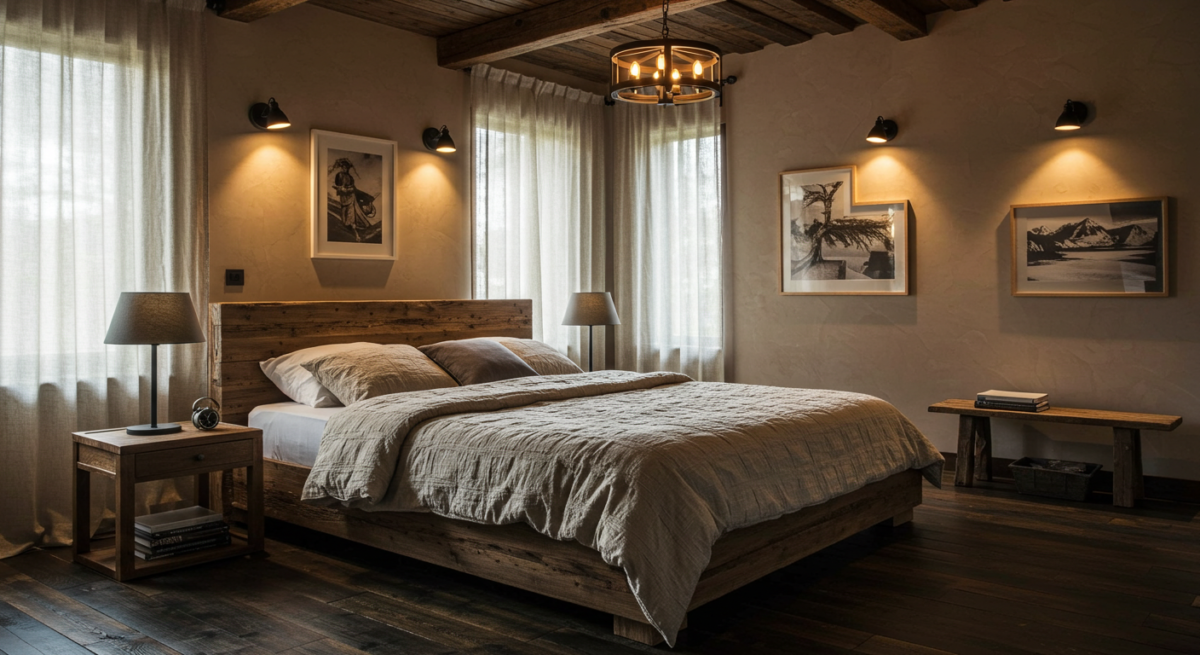
Wall sconces offer some brilliant advantages in bedroom interior lighting design. These fixtures save valuable nightstand space whilst providing both decorative elements and functional lighting. For maximum effectiveness, ensure lampshades align with your eye level when sitting up in bed to prevent harsh glare.
Bedside lamps typically provide adjustable, directional light that can be positioned precisely where needed. This makes them perfect for focused activities like reading or working in bed.
For master bedroom lighting design ideas with ultimate versatility, consider combining both options. A wall sconce creates ambient glow throughout the room, whilst a lamp delivers targeted illumination. This layered approach allows customisation based on your specific needs at any moment.
Building calm lighting into your evening routine
Establishing a consistent lighting routine signals to your body that it's time for sleep. Start by switching to lower brightness levels whilst reading or unwinding before bed. Dim lighting enables reading without over-stimulating your senses.
Avoid harsh, bright lights in your eyes before sleeping. Soft bedroom lighting with warm tones creates a cosy atmosphere conducive to relaxation. Bedside luminaires with clear glass shades or visible bulbs should be avoided as they create unwanted glare.
Your evening lighting routine should follow these simple steps: First, dim your lights approximately two hours before bedtime. Second, engage in calming activities like reading. Third, gradually reduce illumination further as you prepare to sleep.
Create your perfect sleep sanctuary tonight
Getting better sleep really can be as simple as changing your bedroom lighting. The connection between light and sleep isn't just theory – it's science that you can put to work in your own home.
Remember, your bedroom lighting choices directly affect how well you sleep. Blue light from screens and harsh overhead lights disrupts your natural sleep hormones, while warm, dim lighting actually helps your body prepare for rest.
The best bedroom lighting setup combines three simple elements: ambient lighting for overall glow, task lighting for activities like reading, and accent lighting to create that cosy atmosphere. Don't forget the power of dimmers – they give you complete control over brightness levels as evening approaches.
Smart lighting has made creating the perfect sleep environment easier than ever. These systems can automatically dim your lights like a natural sunset and wake you gently like sunrise. Even simple bedside lamps and wall sconces, when positioned thoughtfully, can make a huge difference to your sleep quality.
Small changes in your lighting can lead to big improvements in how you sleep. Many people notice better rest within just a few nights of adjusting their bedroom lighting routine.

Your next steps
Start tonight by dimming your bedroom lights about two hours before bedtime. Choose warm colour temperatures between 2000K and 3000K for your bedroom fixtures. Most importantly, stick to a consistent routine – your body will learn to recognise these lighting cues as signals that it's time to wind down.
Sweet dreams begin with the right lighting choices. Transform your bedroom into the restful sanctuary you deserve, and enjoy the better sleep that follows.
FAQs
Q1. How does bedroom lighting affect sleep quality? Bedroom lighting significantly impacts sleep quality by influencing melatonin production and circadian rhythms. Warm, dim lighting in the evening supports natural sleep cycles, while exposure to blue light from electronic devices can disrupt rest.
Q2. What is the ideal colour temperature for bedroom lighting? The ideal colour temperature for bedroom lighting is between 2000K and 3000K. This range produces warm, amber-toned light that resembles sunset or candlelight, signalling to your body that it's time to wind down and prepare for sleep.
Q3. How can smart lighting improve sleep habits? Smart lighting systems can automate sunset-like dimming sequences and sunrise simulations, working with your body's natural rhythms. They allow for customisable settings, voice control, and can be programmed to gradually adjust brightness and colour temperature throughout the day and night.
Q4. What's the best way to layer bedroom lighting? The best way to layer bedroom lighting is to combine ambient, task, and accent lighting. This approach typically includes a main ceiling light for overall illumination, bedside lamps or wall sconces for reading, and decorative lights for ambiance. Each type should be on separate switches or dimmers for maximum flexibility.
Q5. How bright should bedroom lighting be in the evening? In the evening, bedroom lighting should be soft and not excessively bright. Experts recommend using lower lumen outputs and gradually reducing brightness as bedtime approaches. Dimming lights to around 10 lux about two hours before bed can help signal to your brain that it's time to sleep.